
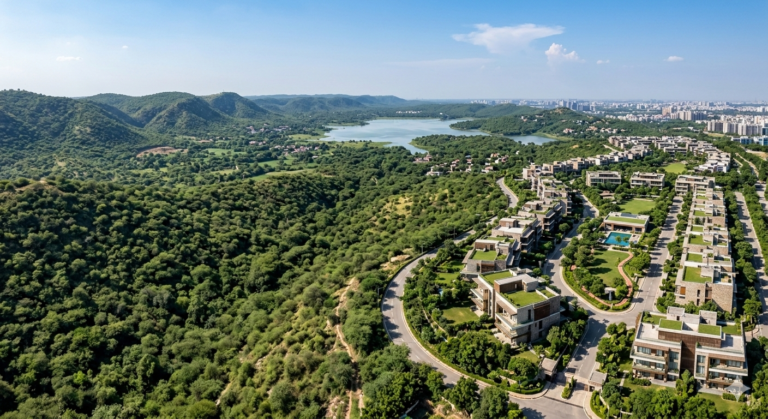
The landscape of Gurgaon real estate is undergoing a profound transformation, but not all growth is viewed through a lens of unmitigated progress. Recently, reports emerged of significant land leveling, tree felling, and the carving of new roads within the Damdama basin—a critical catchment area of the Aravali hills. For investors and homeowners, these developments are more than just news; they represent a pivotal moment in how we define sustainable property investment in Gurgaon. While the demand for luxury retreats and expansive farmhouses continues to soar, the legal and environmental frameworks protecting our “green lungs” are tightening. Consequently, understanding the balance between development and conservation has become essential for anyone looking to navigate the Millennium City’s property market. This blog explores the recent events at Damdama Lake and what they mean for the long-term viability of the region’s real estate.
The Ecological Significance of the Damdama Basin
Historically, the Aravali Range has served as a natural barrier against the eastward expansion of the Thar Desert, while simultaneously acting as the primary groundwater recharge zone for the NCR. The Damdama basin, in particular, is governed by Sections 4 and 5 of the Punjab Land Preservation Act (PLPA). This legislation strictly prohibits non-forest activities without explicit statutory approval. According to data from the Central Ground Water Board (CGWB), much of the Sohna block, where Damdama is located, has been categorized as a “dark zone” due to rapidly depleting water tables.
In early 2026, investigations revealed that a kuccha road, which was previously blocked by the forest department, had nearly doubled in length to 3km. This road was designed to provide access to newly raised concrete structures and fenced plots. Furthermore, the extension of electricity lines into these protected zones signaled a bold move toward permanent habitation in an area meant for conservation. However, as the Supreme Court of India has frequently noted in various environmental litigations, the “precautionary principle” must prevail in the Aravalis to prevent irreversible ecological damage.
Why Regulatory Compliance is Non-Negotiable
When considering sustainable property investment in Gurgaon, investors must look beyond the immediate aesthetic appeal of a hillside view. The recent crackdown by the Haryana Forest Department, which saw the dismantling of illegal fencing and the clearing of debris in the Damdama catchment, serves as a stark reminder of the risks involved in non-compliant developments.
1. The Risk of Encroachment on Protected Land
The allure of “gair mumkin pahad” (uncultivable hill) land often leads to unauthorized constructions. However, these structures are frequently subject to demolition drives. For a buyer, this means that an investment made without verifying the land’s status under the PLPA could result in total capital loss. Therefore, it is vital to ensure that any property purchase aligns with the latest master plans and environmental notifications.
2. Impact on Groundwater and Hydrology
Levelling land and felling trees in a catchment area disrupts the natural flow of monsoon runoff. This runoff is what feeds Damdama Lake and replenishes the local aquifers. If the recharge cycle is weakened, the resulting water scarcity will inevitably lead to a decline in property values across the entire Sohna and South Gurgaon belt. For this reason, sustainable property investment in Gurgaon must prioritize projects that respect natural drainage patterns.
3. The Shift Toward Organized Real Estate
The uncertainty surrounding individual farmhouse plots in the Aravalis is pushing smart investors toward organized developments. Major news outlets like The Times of India have highlighted how “piecemeal development” often lacks the necessary infrastructure and legal clearances. In contrast, RERA-approved projects in designated urban zones offer a safer, more transparent route for those seeking the Gurgaon lifestyle.
4. Legal Precedents and the 100-Metre Rule
The ongoing debate in the judiciary regarding the definition of “Aravali Hills”—specifically whether only landforms above 100 metres qualify for protection—has created a temporary grey area. Nevertheless, the National Green Tribunal (NGT) remains vigilant. Investors should be cautious of any project that seeks to exploit these definitional loopholes, as the courts are increasingly favoring landscape-level restoration over technical exclusions.
How Gurgaonfloors Can Help You Navigate the Market
At gurgaonfloors, we understand that the complexities of the Gurgaon real estate market can be daunting, especially when environmental regulations are involved. Our team of experts specializes in identifying properties that are not only luxurious but also legally sound and environmentally conscious. We provide comprehensive due diligence services to ensure that your sustainable property investment in Gurgaon is protected from future regulatory shifts.
Whether you are looking for independent floors in the heart of the city or luxury apartments near the scenic Aravali foothills, we guide you through the maze of PLPA notifications and RERA filings. Visit gurgaonfloors.in to explore our curated listings. We pride ourselves on being more than just consultants; we are your partners in building a secure and prosperous future in Gurgaon’s ever-evolving landscape. By choosing us, you ensure that your investment contributes to the city’s growth without compromising its ecological integrity.
Frequently Asked Questions (FAQs)
1. Is it legal to build a farmhouse near Damdama Lake?
Construction in the Damdama catchment is strictly regulated under the PLPA. Most areas are designated for conservation, and non-forest activities like building permanent concrete structures are generally prohibited without prior approval from the Forest Department. Always verify the land’s “Gair Mumkin Pahad” status before investing.
2. What is the “dark zone” in Gurgaon real estate?
A “dark zone” refers to an area where groundwater extraction exceeds the rate of recharge. Much of Gurgaon and Sohna are in this category. For a sustainable property investment in Gurgaon, it is crucial to check if the project has a sustainable water management plan or access to treated canal water.
3. How can I check if a property has environmental clearances?
You should request the developer’s Environment Clearance (EC) certificate and check the project’s status on the Haryana RERA website. For land in the Aravali periphery, a “No Objection Certificate” (NOC) from the Forest Department is essential to ensure you aren’t investing in a protected zone.
Add a comment