
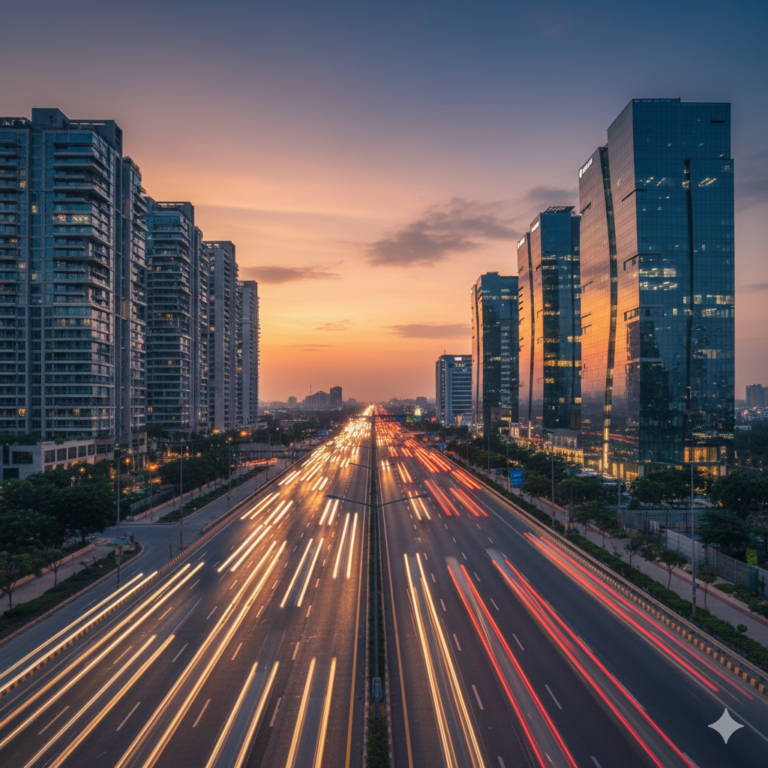
In the fast-paced world of property investment, one mantra has remained unshakable: connectivity is king in Gurgaon. As we navigate the economic landscape of 2026, this statement has evolved from a simple marketing slogan into a fundamental truth for every stakeholder. The city’s transition from a satellite town to a global business powerhouse was fueled by its roads and rails. Today, the relationship between infrastructure and Return on Investment (ROI) is more direct than ever. High-speed expressways and expanded metro corridors are no longer just “amenities”—they are the primary engines of value. For investors, a property’s worth is now measured by the minutes it takes to reach the IGI Airport or the nearest corporate hub. In this blog, we explore how the city’s expanding transit networks are reshaping commercial demand and residential wealth, proving once again that in the Millennium City, mobility equals money.
The 2026 Infrastructure Boom
The year 2026 marks a pivotal moment for Gurgaon’s physical footprint. The Dwarka Expressway has moved past its construction phase to become a fully functional “growth spine,” slashing travel times to Delhi’s urban core to under 20 minutes. Simultaneously, the National Highways Authority of India (NHAI) is nearing the completion of the Gurugram–Pataudi–Rewari Highway, with major sections expected to be operational by March 2026. You can find official project updates and safety guidelines on the NHAI website.
Furthermore, the state government’s focus on Transit-Oriented Development (TOD) has turned the spotlight onto the Metro expansion. With the Gurugram Metro Rail Limited (GMRL) initiating major construction on the Millennium City Centre to Cyber City loop, the city is finally bridging the gap between “Old” and “New” Gurgaon. For residents, this means a significant reduction in the “commute tax”—the time and money lost in traffic. According to data from the Haryana Government’s Official Portal, these projects are part of a broader vision to integrate the NCR into a seamless economic zone. This massive capital infusion confirms that connectivity is king in Gurgaon and remains the most reliable predictor of property appreciation.
The ROI of a Well-Connected Address
To understand why connectivity is king in Gurgaon, one must look at the data behind office absorption and residential demand. When a new road opens, it doesn’t just move cars; it moves the entire economy of the surrounding sectors.
1. The Commercial Magnet: Grade-A Office Demand
Gurgaon’s office stock is nearing a monumental 100 million sq. ft. in 2026. However, this demand is not evenly distributed. Global Capability Centres (GCCs) and tech giants are showing a “flight to quality,” meaning they are clustering in areas with superior highway access. For instance, the Southern Peripheral Road (SPR) has seen a surge in commercial leasing because it connects the Delhi–Mumbai Expressway to the established Golf Course Road. For investors, commercial assets in these transit-corridors are yielding 8–10% rental returns, significantly higher than the national average.
2. Residential Appreciation: The “Metro Premium”
History shows that properties located within 500–800 meters of a metro station command a 10%–20% price premium. In 2026, this trend is intensifying as the Delhi Metro Phase 4 priority corridors become operational. For a detailed look at the new lines, you can visit the Delhi Metro Rail Corporation (DMRC) site. Buyers are willing to pay a premium for the certainty of a signal-free commute. This is why connectivity is king in Gurgaon—it provides a “floor” for property prices, ensuring they remain resilient even during market fluctuations.
3. Last-Mile Connectivity and Social Infrastructure
Modern connectivity is more than just big highways; it includes flyovers at busy junctions like Ambedkar Chowk and Sati Chowk, which the GMDA is currently finalizing. These smaller interventions remove bottlenecks, making local micro-markets like Sectors 70–76 more attractive for families. When the daily friction of travel is removed, the “livability quotient” of a sector rises, leading to higher occupancy rates and better ROI.
How Gurgaonfloors Can Help You
At gurgaonfloors, we recognize that an investment is only as good as the road leading to it. Our expertise lies in identifying “early-mover” opportunities in sectors that are about to benefit from upcoming infrastructure milestones. Because we believe connectivity is king in Gurgaon, we meticulously vet every listing for its proximity to planned metro stations and highway exits.
By visiting gurgaonfloors.in, you can access an exclusive database of premium floors and commercial spaces that are strategically positioned for maximum appreciation. We provide our clients with “Connectivity Maps” and transit-impact reports, helping you visualize how 2026’s infrastructure will boost your property’s value by 2030. Whether you are looking for a luxury residence on the Dwarka Expressway or a high-yield office on the SPR, our team ensures your investment is on the right track.
FAQs
Q1: How much ROI can I expect from properties near the Dwarka Expressway in 2026?
Properties along the Dwarka Expressway are seeing an annual appreciation of 12%–18%, driven by its now-operational status and proximity to the IGI Airport.
Q2: When will the new Gurgaon Metro loop become operational?
Major construction is underway in 2026, with the loop connecting Millennium City Centre to Cyber City and the Dwarka Expressway expected to be ready for public use around 2029.
Q3: Why is connectivity more important than the property’s size?
A smaller property in a well-connected hub like Cyber City will often yield higher rents and have better liquidity than a larger villa in an isolated area, as professionals prioritize short commutes.
Add a comment