
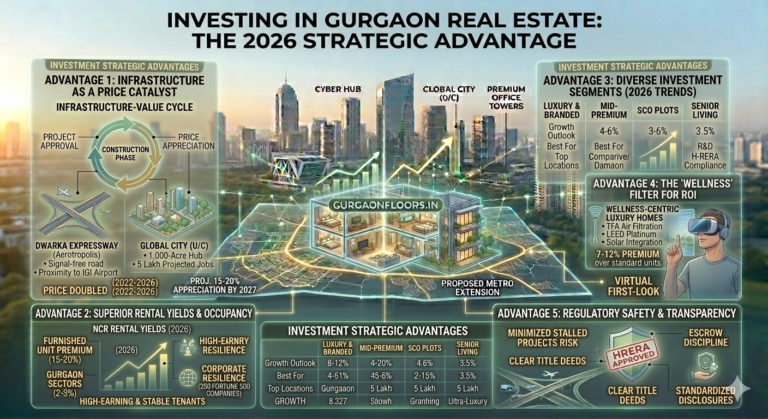
The Transformation of the Millennium City
In 2026, Gurgaon (Gurugram) has transcended its reputation as a mere satellite city to become a global economic powerhouse. The “Millennium City” is no longer growing on speculation but on a robust foundation of completed infrastructure and institutional capital. With projects like the Dwarka Expressway and Global City reaching critical operational milestones, the benefits of investing in Gurgaon real estate have never been more tangible.
For investors, 2026 represents a shift from “fast flips” to high-quality, long-term wealth creation. This blog breaks down why Gurgaon continues to outperform other NCR markets and how you can capitalize on its structural growth.
1. Infrastructure as a Price Catalyst
The single most significant benefit of the Gurgaon market is the visible, high-impact infrastructure delivery. Unlike other regions where projects remain on paper, Gurgaon’s connectivity upgrades directly correlate with property value spikes.
- Dwarka Expressway (The Aerotropolis): With the expressway fully functional, travel time to IGI Airport has dropped significantly. Sectors like 102–113 have seen prices double since 2022, with a projected further 15–20% appreciation by 2027 as social infrastructure matures.
- The Global City Impact: This 1,000-acre “city within a city” (Sectors 36A, 37, 37D) is the new urban blueprint. It is expected to generate over 5 lakh jobs, creating a massive “Rental Vacuum” in surrounding sectors (84, 88, 89, and 93).
- Metro Expansion: The extension of the Metro into New Gurgaon and along the Southern Peripheral Road (SPR) is transforming peripheral areas into prime residential hubs.
2. Superior Rental Yields and Occupancy
Gurgaon remains India’s largest private-sector employment hub, hosting over 250 Fortune 500 companies. This corporate density ensures a perennial demand for high-quality housing.
- Corporate Resilience: The influx of Global Capability Centres (GCCs) and tech giants like Google and Microsoft ensures that the tenant profile remains high-earning and stable.
- Yield Comparison: While residential yields in other Indian metros hover around 2–3%, Gurgaon’s prime micro-markets (like Golf Course Extension and SPR) are delivering 4–6%.
- Furnished Unit Premium: Investors opting for “ready-to-move” furnished units are seeing faster occupancy and a 15–20% rental premium compared to bare-shell apartments.
3. Diverse Investment Segments (2026 Trends)
In 2026, the market offers specialized niches that cater to varying risk appetites:
| Segment | Growth Outlook | Best For | Top Locations |
| Luxury & Branded | High (10–12% p.a.) | HNIs & NRIs | Sector 65, Golf Course Rd |
| Mid-Premium | Stable (7–9% p.a.) | Families & End-users | New Gurgaon (82–95) |
| SCO Plots | Rapid Growth | High-Yield Portfolios | Sector 88, 114 |
| Senior Living | Emerging | Niche Diversification | Sohna Road |
4. Regulatory Safety and Transparency
The Haryana Real Estate Regulatory Authority (HRERA) has become a benchmark for transparency. In 2026, the risk of “stalled projects” is at a historical low.
- Escrow Discipline: Mandatory escrow accounts ensure that your funds are used solely for the construction of your specific project.
- Standardized Disclosures: Buyers now have access to real-time construction updates and clear title deeds, making Gurgaon a safe haven for NRI investment.
Strategic Advice for 2026 Investors
To maximize the benefits of your Gurgaon investment, move beyond the “brochure hype”:
- Prioritize RTM (Ready-to-Move): In the current cycle, ready properties command higher rents and eliminate construction risk.
- Focus on the “15-Minute City”: Invest in projects within a 15-minute radius of the major employment hubs like Cyber City or the upcoming Global City.
- Sustainability Factor: Properties with LEED certification or “Wellness” features (TFA air filtration, solar integration) are seeing higher resale liquidity.
FAQs:
1. Is 2026 a good time to buy, or should I wait for a price correction?
With infrastructure like the Global City and Delhi-Mumbai Expressway integration reaching maturity, a significant correction is unlikely. Prices are expected to stabilize into a “Quality-Driven” growth phase of 8–10% annually rather than sharp speculative spikes.
2. Which is better: Residential or Commercial?
For passive income, Grade A commercial spaces or SCO plots offer higher yields (7–9%). For long-term capital growth and lifestyle value, Luxury Residential in high-scarcity zones remains the winner.
3. What are the “hidden costs” in 2026?
Always budget for Stamp Duty (7% for men, 5% for women) and Registration fees, which can add roughly 8–10% to your total outflow for a ₹1.5 Cr+ property.
Add a comment