
From Square Footage to Oxygen Levels
A decade ago, the prestige of a Gurgaon home was measured by its Italian marble, infinity pools, and proximity to the Golf Course. In 2026, the metrics of “luxury” have taken a biological turn. As the National Capital Region (NCR) continues to grapple with seasonal smog and urban heat islands, clean air in Gurgaon real estate has transitioned from a basic human right to a premium architectural feature.
Today’s HNI (High Net Worth Individual) and NRI buyers are no longer just asking about the floor plan; they are asking about the MERV rating of the air filtration system and the “Green Plot Ratio” of the township. In 2026, wellness isn’t an amenity—it is the ultimate status symbol.
The Rise of “Breathing-First” Architecture
The shift is driven by a stark reality: according to the Central Pollution Control Board (CPCB), indoor air can be up to five times more polluted than outdoor air if not managed correctly. This has birthed a new category of wellness-centric luxury homes in Gurgaon.
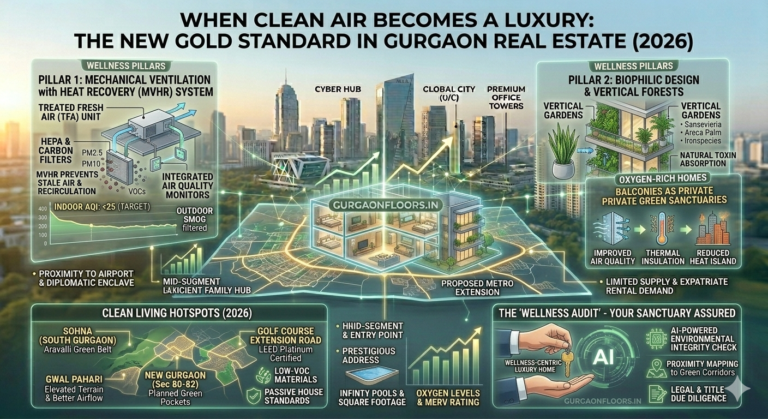
Developers like DLF, Tata Housing, and M3M have pivoted toward “Passive House” standards. This involves airtight building envelopes combined with sophisticated Mechanical Ventilation with Heat Recovery (MVHR) systems. By 2026, the “Smog-Free Tower” is no longer a public infrastructure project—it is a standard feature in the central courtyards of ultra-luxury condominiums.
What Defines an “Oxygen-Rich” Home?
If you are scouting for a home in 2026, these are the technological benchmarks that separate a standard apartment from a true wellness retreat:
1. Centralized Treated Fresh Air (TFA) Units
Unlike traditional ACs that simply recirculate stale indoor air, modern Gurgaon luxury floors use TFA units. These systems pull in outside air, run it through multi-stage HEPA and carbon filters, and “scrub” it of PM2.5 and PM10 particles before cooling and distributing it into your rooms.
2. Real-Time AQI Dashboards
Luxury homes now come with integrated “Air Quality Monitors” in every room. These sensors sync with your smartphone or home automation hub, providing real-time data on CO2 levels, VOCs (Volatile Organic Compounds), and humidity, automatically adjusting ventilation speeds to maintain an indoor AQI of under 25.
3. Biophilic Design & Vertical Forests
The 2026 aesthetic is “Green.” Projects in Sectors 63 and 65 are incorporating “Vertical Forests”—balconies equipped with automated irrigation systems and specific plant species known for high oxygen output and toxin absorption (like Sansevieria and Areca Palm).
4. Low-VOC Materials
True luxury is invisible. Developers are now strictly using non-toxic, low-VOC paints, adhesives, and sustainable flooring materials to ensure that the home itself doesn’t “off-gas” harmful chemicals into the purified air.
Strategic Hotspots for Clean Living (2026)
| Micro-Market | Air Quality Advantage | Property Type |
| Sohna (South Gurgaon) | Proximity to the Aravalli Green Belt; lower density. | Luxury Independent Floors |
| Gwal Pahari | The “Lungs of Gurgaon”; elevated terrain with better airflow. | Ultra-Luxury Penthouses |
| New Gurgaon (Sec 80-82) | Wider roads and massive planned green pockets. | Gated Townships |
| Golf Course Ext. Road | Highest concentration of LEED Platinum-certified buildings. | Branded Residences |
How Gurgaonfloors Curates Your Wellness Sanctuary
At gurgaonfloors.in, we recognize that your home should be your safest sanctuary. We don’t just vet properties for legal titles; we vet them for “Environmental Integrity.”
- The Wellness Audit: We help our clients analyze the HVAC specifications of a project before they sign the BBA.
- Proximity Mapping: We prioritize listings that are situated away from heavy industrial zones and “congestion bottlenecks,” focusing instead on the “Green Corridors” of Gurgaon.
- Secondary Market Specialists: If you are looking for a resale unit, we help you identify homes where the owners have invested in high-end retrofitted air purification systems.
FAQs:
1. Does a ‘Green Building’ certification guarantee clean air?
LEED or IGBC certification is a great start, as it mandates certain ventilation standards, but you should still check if the developer has installed active air purification (TFA) or if it’s purely passive design.
2. Are independent floors better for air quality than high-rises?
High-rises (above the 10th floor) often have slightly better air quality as they are further from ground-level road dust. However, independent floors in low-density sectors like Sohna offer better cross-ventilation and proximity to private gardens.
3. What is the cost premium for a ‘Wellness’ home?
In 2026, homes with integrated air purification and wellness features typically command a 7% to 12% premium over standard units. However, the long-term health benefits and higher resale value often justify the cost.
4. Can I retrofit my existing Gurgaon home for clean air?
Absolutely. We can connect you with specialized consultants who install centralized HEPA-filtration units and “positive pressure” systems into existing residential structures.
Add a comment