
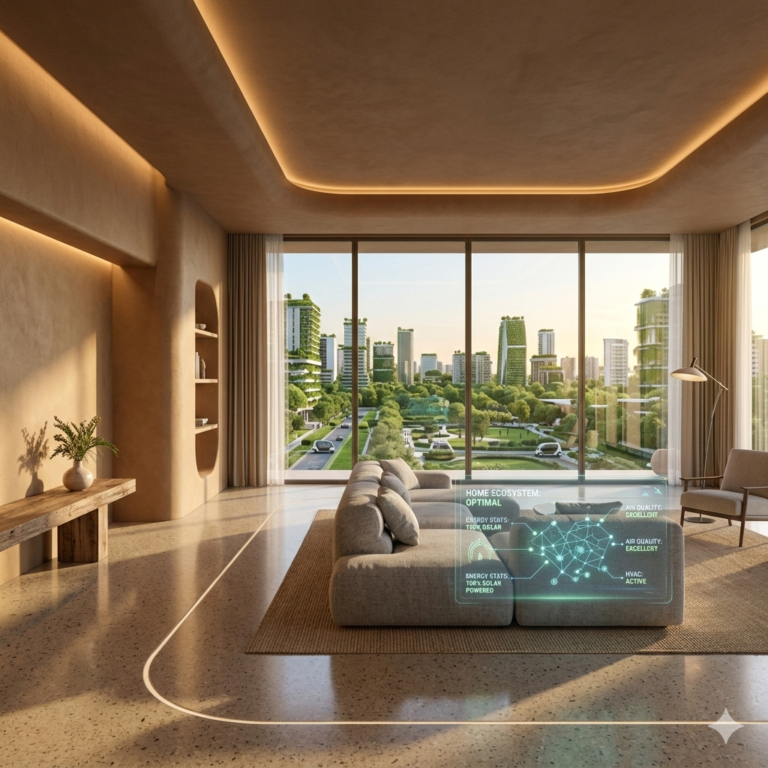
As we stand in 2026, the concept of a “connected home” has transitioned from a luxury novelty to a fundamental residential expectation. However, looking toward the end of the decade, the shift will be even more radical. By the time we reach the next milestone, smart homes 2030 will no longer be defined by voice-controlled lights or automated blinds. Instead, they will function as living, breathing ecosystems that anticipate human needs through advanced artificial intelligence and ambient sensing. The future of home automation is moving toward “invisible technology”—where the hardware disappears into the architecture, and the software manages everything from energy efficiency to preventative healthcare. In this blog, we explore the technological pillars that will make smart living the absolute gold standard for real estate in the next four years.
From Gadgets to Integrated Ecosystems
The journey toward smart homes 2030 began with isolated devices, but the current market in India is witnessing a massive consolidation phase. According to the Ministry of Electronics and Information Technology (MeitY), India’s IoT (Internet of Things) market is expected to grow exponentially, driven by 5G expansion and the “Smart Cities Mission.”
Historically, homeowners faced the “walled garden” problem—where different brands’ devices wouldn’t talk to each other. The introduction of the ‘Matter’ protocol has finally unified the industry. In Gurgaon specifically, premium developers are already moving away from “automation-ready” shells to “fully integrated” living units. As reported by The Economic Times, the demand for tech-enabled luxury floors has surged by 35% since 2024, signaling that the future of home automation is the primary driver of property valuation in the NCR region.
The Pillars of Smart Living in 2030
To understand why smart homes 2030 will dominate the market, we must look at the specific innovations currently moving from labs to our living rooms. The future of home automation rests on three main pillars:
1. Predictive Artificial Intelligence (AI)
Currently, we tell our homes what to do. By 2030, the home will tell us what it is doing for us. Using “Behavioral Biometrics,” your home will recognize your stress levels through voice pitch or heart rate sensors embedded in furniture. It will automatically adjust the circadian lighting (simulating natural sunlight) and temperature to optimize your recovery.
2. Energy Autonomy and V2H Technology
Sustainability is no longer optional. Future smart homes will act as micro-power plants. Through Vehicle-to-Home (V2H) technology, your electric vehicle (EV) will not just draw power from the house; it will feed power back during peak hours. Advanced AI will manage the “smart grid,” selling excess solar energy back to the city, making the future of home automation a financially self-sustaining venture.
3. Health-Centric Architecture
The home of 2030 will be your primary healthcare provider. Smart mirrors will perform non-invasive skin scans, and smart flooring will detect gait changes or falls (crucial for elderly care). Air purification systems will use HEPA-14 filters and UV-C light to neutralize pathogens in real-time, governed by air quality sensors that communicate directly with the local weather station.
4. The “Matter” Standard and Interoperability
By 2030, the friction of setting up a smart home will vanish. Every appliance, from your refrigerator to your front door lock, will operate on a universal language. This interoperability ensures that your real estate investment remains future-proof, as you can swap components without rebuilding the entire system.
Investor Insight: Properties equipped with integrated smart systems see a 15-20% higher resale value compared to traditional homes. For the latest standards on green building and tech integration, refer to theIndian Green Building Council (IGBC).
How Gurgaonfloors Prepares You for the Future
At gurgaonfloors.in, doesn’t just help you buy or sell a property—they prepare you for the future. From understanding market trends and price movements to evaluating long-term investment potential, a consultant ensures that every decision aligns with your financial goals. They assess location growth, infrastructure developments, and resale value so you invest wisely today and benefit tomorrow. Whether it’s planning for rental income, upgrading to a bigger home, or building a diversified property portfolio, a real estate consultant provides strategic guidance at every step. With expert insights, risk assessment, and personalized advice, they help you secure not just a property, but a stable and rewarding future.
FAQs:
1. Will my current smart devices work in 2030?
Most devices supporting the ‘Matter’ protocol will remain compatible. However, the future of home automation will rely heavily on edge computing, so older devices might require a central “smart hub” upgrade to handle advanced AI tasks.
2. Is data privacy a concern in smart homes 2030?
Privacy is the top priority. Future systems will move toward “Local Processing,” where your data never leaves your home’s private server. Leading security firms, often cited by CERT-In, are developing blockchain-based encryption for residential IoT.
3. Does a smart home significantly increase electricity bills?
On the contrary, the future of home automation is focused on efficiency. Smart thermostats and AI-managed lighting typically reduce energy consumption by 25-30% by ensuring power is only used when and where it is needed.
4. Can I retrofit an old Gurgaon floor into a smart home?
Yes, with “Wireless Mesh” technology, you can upgrade any property without breaking walls. At gurgaonfloors.in, we can recommend specialist vendors who handle retrofitting for heritage properties.
Add a comment