
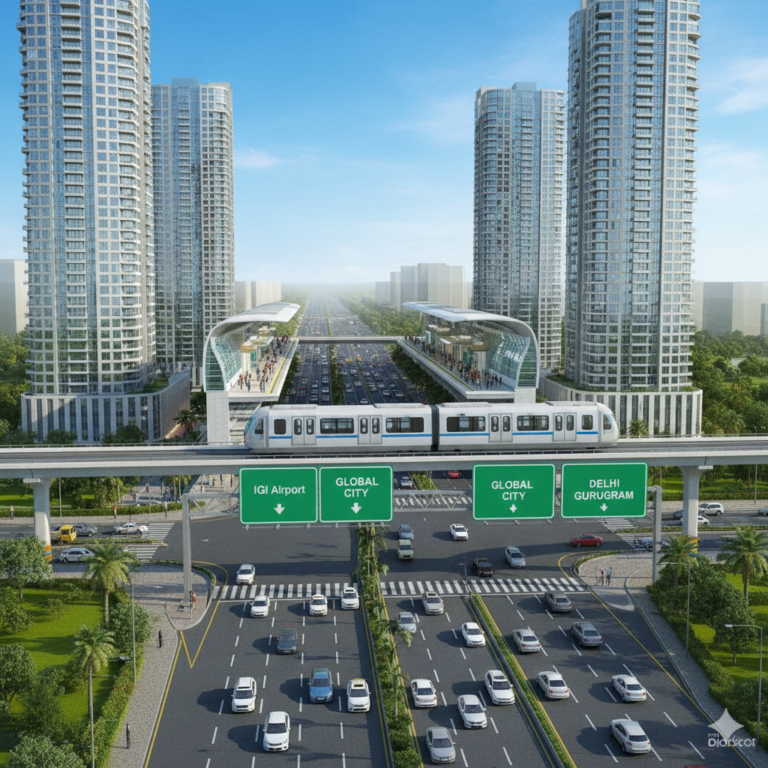
As we move into the first quarter of 2026, the Dwarka Expressway connectivity Gurgaon narrative has shifted from “planned infrastructure” to an “operational lifeline.” This 29-km engineering marvel has done more than just provide an alternative route to NH-48; it has effectively redrawn the map of the National Capital Region (NCR). For homebuyers and investors at gurgaonfloors.in, the expressway is now the primary driver of property value, slashing travel times to the Indira Gandhi International (IGI) Airport and the upcoming Diplomatic Enclave to under 20 minutes. In this blog, we explore how the integration of the Urban Extension Road (UER-II) and the newly launched metro pillars are creating a seamless transit corridor that benefits sectors from 102 to 113 and beyond.
A Multi-Modal Transit Hub in 2026
The historical congestion of the Delhi-Gurgaon Expressway (NH-48) was the primary catalyst for the Dwarka Expressway. However, in 2026, the scope is far broader. According to the National Highways Authority of India (NHAI), the expressway is now the world’s longest elevated urban road, featuring an 8-lane main carriage way and 8-lane service roads.
The recent integration with the Gurugram Metro Rail Limited (GMRL) project has further solidified the region’s status. With the “bhoomi pujan” completed in late 2025, workers are now visible across the corridor as the metro spur from Basai Village to the expressway moves into active construction. This synergy between high-speed road networks and mass rapid transit is what distinguishes the Dwarka Expressway from any other residential hub in India.
Sector-Wise Connectivity Benefits
The Dwarka Expressway connectivity Gurgaon impact is most visible when looking at specific sector clusters. The “ripple effect” of this infrastructure has created three distinct zones of accessibility.
1. The Airport & Delhi Border Cluster (Sectors 106, 111, 113)
These sectors are the “zero-point” beneficiaries. Residents here now enjoy a dedicated 3.6 km shallow tunnel that provides direct, signal-free access to Terminal 3 of IGI Airport. What used to be a 45-minute ordeal through Mahipalpur is now a 10-minute breeze. Furthermore, the proximity to the India International Convention Centre (IICC) in Dwarka Sector 25 has made these sectors a preferred choice for corporate expats and frequent flyers.
2. The Metro & Global City Cluster (Sectors 36A, 37D, 102)
The most significant development of 2026 is the progress of the 1,000-acre Global City. Strategically located between the expressway and NH-48, this project is being developed as a “Central Business District” (CBD).
Connectivity in these sectors is being boosted by the “Metro Spur,” which will link the New Gurgaon residents directly to the Millennium City Centre (formerly HUDA City Centre) and the Delhi Metro Yellow Line. This “last-mile connectivity” is the final piece of the puzzle that has historically kept these sectors from reaching their full potential.
3. The West Gurgaon Reach (Sectors 88A, 89, 95)
The expressway has unlocked these “New Gurgaon” sectors by providing a high-speed link to Manesar and the KMP Expressway. Professional commuters working in the IMT Manesar industrial hub can now bypass the Kherki Daula toll, reducing their daily travel time by nearly 40%. As reported by The Times of India, the completion of internal sector roads has ensured that even the innermost pockets of Sector 95 are now within 5 minutes of the main expressway.
How Gurgaonfloors Can Help
At Gurgaonfloors, we understand that connectivity is the single most important factor for long-term capital appreciation. Our experts at gurgaonfloors.in provide curated listings specifically in sectors that sit at the intersection of the Expressway and the upcoming Metro line. We offer:
- Strategic Location Mapping: We help you choose floors in sectors like 103 and 106 that offer the best “walking distance” to proposed metro stations.
- Infrastructure Audits: We track the progress of the Global City and UER-II to advise you on the best exit or entry points for your investment.
- Connectivity Tours: Book a site visit with us, and we will demonstrate the actual commute times from your potential new home to key hubs like Cyber City and Aerocity.
FAQs
1. How has the Dwarka Expressway affected travel time to Delhi?
The expressway has reduced travel time from Gurgaon sectors to Dwarka and West Delhi by approximately 50-60%, with many sectors now reaching the border in under 15 minutes.
2. Is there a metro station directly on the Dwarka Expressway?
Yes, as part of the Phase 2 Gurugram Metro expansion, a spur line is currently under construction that will have a dedicated station connecting the expressway to the wider NCR metro network.
3. Will the Kherki Daula toll still affect residents?
Most sectors along the Dwarka Expressway can now use the Central Peripheral Road (CPR) and the expressway itself to bypass the toll entirely when traveling towards Delhi or Manesar.
Add a comment